Research, awareness and education on eating disorders in men
Masculinity and body image is a research, awareness and training project developed by Proyecto ART to make visible a reality that is still poorly recognized: eating disorders, body shame, muscle dysmorphia, compulsive exercise and body-related suffering also affect men.
For decades, eating disorders have often been explained through a female stereotype: a young, thin girl who is afraid of gaining weight. This image has helped society recognize part of the problem, but it has also left many forms of suffering outside the conversation.
In many men, distress does not necessarily appear as a wish to lose weight. It may appear as the pursuit of muscularity, leanness, performance, control, discipline, “healthy living”, obsessive training or fear of losing muscle mass.
This project has a clear mission: to raise awareness. We want to broaden the conversation, improve early detection and help families, professionals, schools, gyms, companies, media and society recognize this phenomenon more accurately.

Why this project matters
Eating disorders in men are still underdiagnosed, undertreated and misunderstood. Not because they are rare or unimportant, but because they often hide behind behaviors that are socially accepted or even admired.
A man who trains intensely may look disciplined.
A man who controls his diet may look healthy.
A man who never rests may look strong.
A man who does not ask for help may look independent.
But sometimes, behind this appearance of control, there is anxiety, shame, rigidity, comparison, isolation and suffering.
Many men do not recognize themselves in the phrase “eating disorder”. They may feel that it does not apply to them, that they should be able to manage it alone, or that talking about body, food and vulnerability does not fit the masculinity they have learned.
This silence delays help. When suffering becomes chronic, it can affect mental health, social life, self-esteem, sexuality, sports, eating, rest and identity.
The phenomenon: when the body becomes armor
In this project, we understand that for many men the body is not only about appearance. It can become a form of identity, protection and control.
Sometimes the body becomes armor:
- if I am strong, maybe no one will see my insecurity;
- if I am lean, maybe I will feel more valuable;
- if I control food, maybe I will feel I control my life;
- if I train without stopping, maybe I will not have to feel other things;
- if my body performs, maybe I can maintain an image of masculinity that feels safe, competent and desirable.
But armor protects and imprisons at the same time.
This is why we talk about masculinity and body image not only through appearance, but also through shame, vulnerability, performance, social comparison, sexual pressure, social media, sport, fitness culture and expectations about what it means to “be a man”.
How it may appear
Male body-related distress can appear in many forms. Common signs include:
- obsession with gaining muscle or becoming lean;
- intense fear of gaining fat or losing muscle mass;
- compulsive exercise;
- anxiety when training is not possible;
- food restriction disguised as discipline;
- secret binge eating;
- intense guilt after eating;
- problematic use of supplements or substances;
- constant body comparison;
- avoiding social plans because of food or body concerns;
- shame when talking about body image;
- difficulty resting;
- feeling that the body is never good enough;
- need to measure, weigh, control or check;
- self-worth strongly linked to appearance;
- rigidity around “clean” or “correct” eating.
Not all these signs necessarily mean an eating disorder, but they may indicate a relationship with the body that deserves attention, reflection and support.
Our research at Proyecto ART
At Proyecto ART, we work from a clinical, scientific and social perspective. This project is grounded in our experience in eating disorders, psychotherapy, psychiatry, research and clinical work with patients.
Our research and awareness work focuses especially on:
- eating disorders in men and adolescent boys;
- underdiagnosis and stigma;
- muscle dysmorphia and vigorexia;
- the muscularity ideal;
- compulsive exercise;
- masculinity, shame and body image;
- social media, body comparison and appearance pressure;
- athletes and high-performance contexts;
- fitness culture and risky eating behaviors;
- the difference between health, discipline and rigidity;
- prevention and early detection;
- the impact of body image on self-esteem and mental health.
At Clínica ART, we are also developing a specific research line on eating disorders in men, high-performance sport and diagnostic camouflage, including work presented in international scientific contexts. This line connects with our broader work on social media, body image, mental health and eating disorders.
One of our goals is to generate knowledge that is useful beyond academic publications: knowledge that reaches families, schools, coaches, physicians, nutritionists, psychologists, physiotherapists, journalists and men who may not yet have words for what they are experiencing.
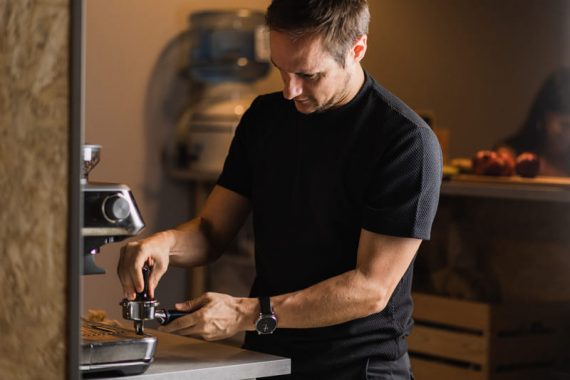
Therapeutic groups and clinical spaces
In addition to research and awareness, Proyecto ART offers therapeutic spaces that allow us to work directly with suffering related to body image, food, self-esteem and identity.
We have therapeutic groups and clinical spaces where we address:
- relationship with the body;
- body shame;
- self-esteem;
- food and control;
- compulsive exercise;
- social comparison;
- masculinity and vulnerability;
- difficulty asking for help;
- pressure to perform;
- social media and external gaze;
- identity, desire, body and relationships.
These spaces also help us understand the phenomenon through real clinical experience, always from an ethical, careful perspective that respects each person’s singularity.
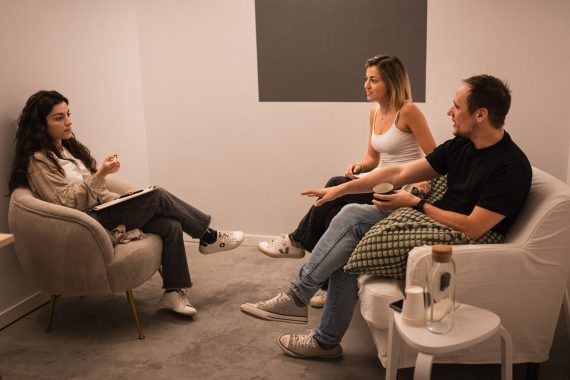
Training, awareness and media
We offer talks, workshops, webinars and collaborations with media, podcasts and press to take this conversation beyond the therapy room. We work with schools, universities, companies, gyms, sports clubs and health professionals to improve early detection of eating disorders in men and speak more clearly about body image, masculinity, shame, exercise and mental health.
Who this project is for
This project is for:
- men who feel that body, food or exercise take up too much space in their lives;
- adolescent boys and young men exposed to body pressure, social media or fitness culture;
- families who want to understand warning signs;
- schools and educational teams;
- universities;
- companies and wellbeing programs;
- gyms, sports clubs and training centers;
- nutritionists, endocrinologists, physicians, physiotherapists and coaches;
- psychologists, psychiatrists and psychotherapists;
- journalists, podcasters and media interested in mental health;
- organizations working on masculinities, suicide prevention, stigma and emotional wellbeing.

Our mission
Our mission is to make visible, investigate and communicate male body-related suffering so that it is no longer mistaken for discipline, strength or vanity.
We want more people to understand that:
- men can also suffer from eating disorders;
- male body shame exists;
- muscle dysmorphia does not explain the whole phenomenon;
- exercise can be health, but it can also become compulsion;
- fitness culture can inspire, but it can also create pressure;
- masculinity can make asking for help harder;
- early detection can change life trajectories.
Talking about eating disorders in men does not minimize other forms of suffering. It broadens the lens. It helps us see those who have been left outside the story.
Collaborations
If you are part of a school, university, company, gym, media outlet, podcast, association or healthcare organization and would like to organize a talk, training, interview or collaboration, you can contact Proyecto ART.
Possible collaborations:
- training for schools;
- workshops for families;
- talks in companies;
- training for gyms and sports clubs;
- sessions for nutritionists, endocrinologists and physiotherapists;
- webinars for mental health professionals;
- podcast interviews;
- press articles;
- roundtables;
- awareness campaigns.